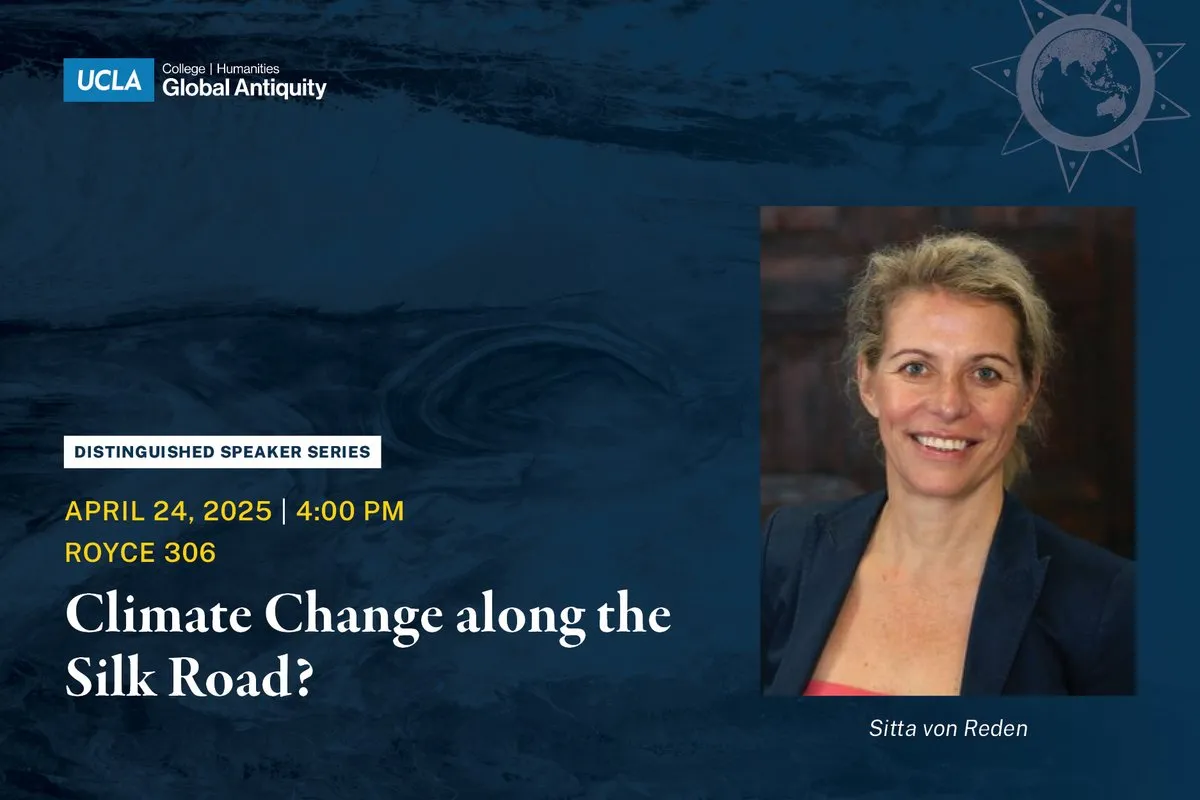
Sitta von Reden: Climate Change along the Silk Road?
Abstract
Climate Change along the Silk Road?
Since the so-called “imperial turn,” it is uncontroversial that particular center-periphery relationships stimulated transimperial connectivity. More recent work, moreover, gives peripheries greater agency in such models, in as much as peripheries are no longer considered only as sites of infrastructural and economic development initiated by imperial centers, but as important agents stimulating transimperial exchange and connectivity through their multi-directional relationships and networks. Within this intellectual context, research on climate-induced landscape transformation in the Tarim Basin (present-day Xinjiang) during the Han period merits attention. Anchoring their research in the Silk Road model, these scholars argue that changes in humidity levels as well as man-made interference with the hydrology of the oases in the eastern Tarim Basin help to explain the growth of Silk Road exchange in the last two centuries before and first century after the turn of the Common Era. This paper will discuss their findings in dialogue with other archaeological and historical research, asking whether and in what ways climate research increases our understanding of global connectivity in a crucial world region such as the Tarim Basin.
Event Video
Sitta von Reden, University of Freiburg
About the Speaker

Sitta von Reden
University of Freiburg
Sitta von Reden is Professor of Ancient History at the University of Freiburg, Germany. Between 2017 and 2023 she directed an interdisciplinary research project on the economy of global connectivity in the Afro-Eurasian world region between 300 BCE and 300 CE. The results of that project are published in the 3-volume Handbook of Ancient Afro-Eurasian Economies (2019–2023).