Wang Rui: New Manichaean Evidence from the Uyghur Court at Yanqi (Ninth-Tenth Centuries CE)
Abstract
New Manichaean Evidence from the Uyghur Court at Yanqi (Ninth-Tenth
Centuries CE)
The Huola Mountain site is located in Qigexing Town, Yanqi County, Bayingolin Mongolian Autonomous Prefecture, Xinjiang Uyghur Autonomous Region. It lies in on the northern foothills of the Huola Mountain of the Tian Shan mountain ranges, 23 kilometers away from the renowned Qigexing Buddhist Temple Site, formerly known as Karashahr.
Excavations carried out by Dr. Wang Rui, the head of an archaeological team that has conducted research at the Huola Mountain from 2024 to 2026, have revealed a site covering approximately 600,000 square meters, including six building foundations and two stupas. It is also enclosed by five defensive terraces and a fort on the eastern, southern and western sides of the site. In 2009, a large, ten‑square‑meter painting on lime plaster was found at this site that was subsequently transferred to the storage of the prefecture Museum at Korla.
In this lecture, Dr. Wang Rui introduces the painting and identifies it as an example of Manichaean art pertaining to the Uyghur Court in the ninth and tenth centuries.
About the Speaker

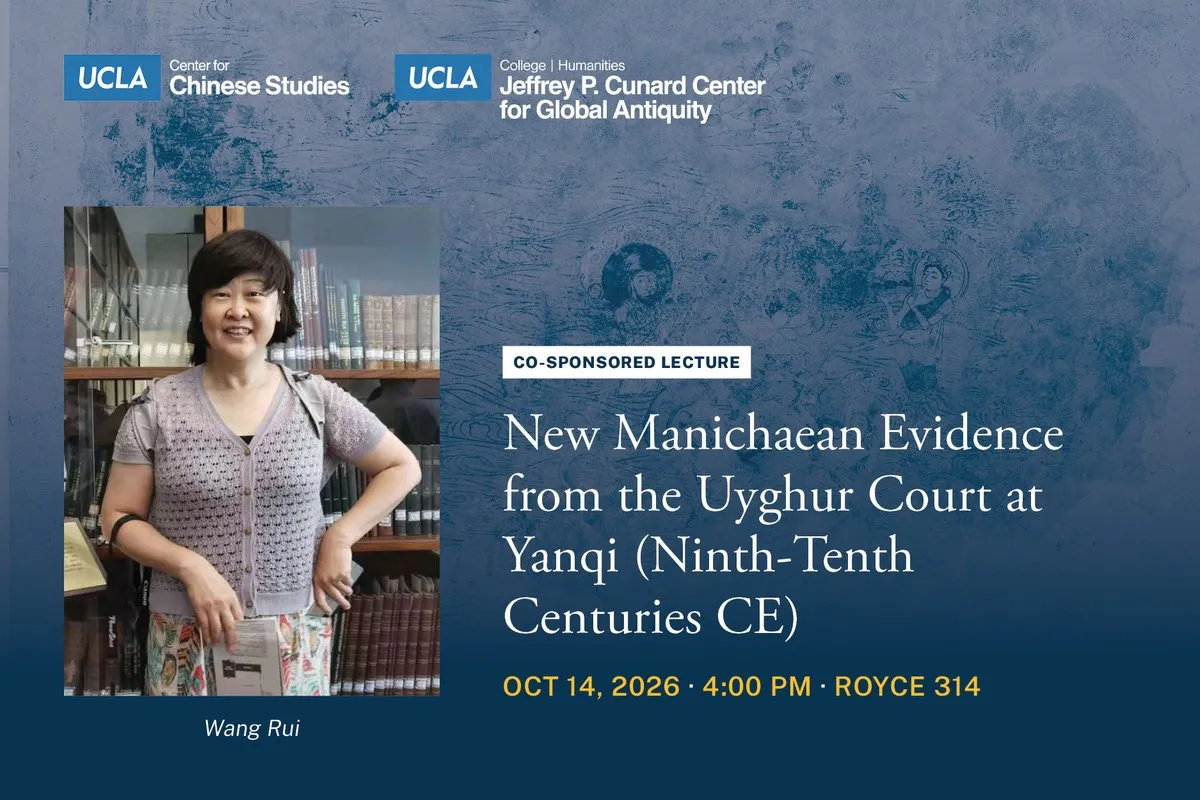
Wang Rui
Palace Museum, Beijing
Dr. Wang Rui is a senior researcher in the Department of Archaeology, Palace Museum in Beijing. She has studied religious art and Chinese ideology by comprehending and comparing the material of archaeology, historical records, and iconography, and has made contributions to the relationship between Buddhism and Daoism by studying the pictures on the Carving Rocks of Kongwangshan, Jiangsu province, and the inspections in the rite of Eight Deities from the ideology of the period of the Warring States and Qinhan Dynasty. Since 2024, Dr. Wang has given attention to the study of religious sites in central Asia. She recognized the paintings collected at the site of Huola Mountain in 2009 as Manichaean art, then began to be in charge of excavating and studying the program of the Huola Mountain site.