Video
Trans-temporal Perspectives on the Moche of Northern Peru: Archaeology, Heritage, and Indigeneity
Abstract
The Moche territory in the North Coast of Peru is one of the cultural areas of the Andes that have drawn the most fascination from scholars studying the deep past. It was home to the earliest processes of domestication, urbanism, and social complexity in the New World. Historical narratives about this region have been mainly dominated by archaeologists who have created compartmentalized visions of the territory whose occupation is seen as a sequence of phases, periods, and cultures. Said narratives, I argue, have precluded trans-temporal perceptions of the cultural landscapes of this region where the line between the precolonial, colonial, and postcolonial can be erased in favor of a focus on the multiplicity of experiences of time and history in the territory. This talk attempts to overcome the excessive emphasis on neo-evolutionary frameworks imposed by archaeologists and move towards a multi-scalar and inter-disciplinary approach of space, time, and bodies that inhabited (and still inhabit) the cultural landscapes of this region. Under this approach, ancient landscapes, huacas and huacos are no longer considered relics of a deep past. Instead, they are dynamic actors within an ever-continuous process of Indigenous identity-making, land tenure, heritage (re)appropriation, and ecological and environmental equilibrium with powerful effects in the present.
Citation
Muro Ynoñán, Luis. “Trans-temporal Perspectives on the Moche of Northern Peru: Archaeology, Heritage, and Indigeneity,” Global Antiquity: Whither Global Antiquity (April 11, 2025).
About the Speaker
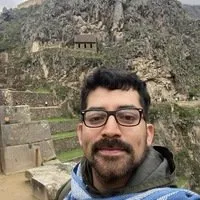
Luis Muro Ynoñán
Field Museum, Chicago
Luis A. Muro Ynoñán (PhD, Stanford) is a Peruvian anthropological archaeologist specializing in the archaeology and heritage of the Moche. He is currently an Assistant Curator of South American Anthropology at the Field Museum of Natural History in Chicago and a Lecturer in Archaeology at the Pontifical Catholic University of Peru in Lima. His research has been awarded with fellowships and grants from various institutions including the Society for American Archaeology, Dumbarton Oaks, Los Angeles County Museum of Art, the Field Museum, the Stanford Institute for Research in the Social Sciences, and the Lilly and Mellon Foundations. He has broad theoretical interests including the study of ancient religion, performance, and monumental landscapes, as well as heritage ethics, rights, and decoloniality. He is currently the director of the Zaña Cultural Landscape Archaeological Project in Lambayeque, Peru. Through this project, he examines the emergence of Moche religion and religious monumental landscapes in relationship to climatic oscillations documented for the 1st millennium CE in northern Peru.